
Konoha Tenmoku
Leaf tenmoku
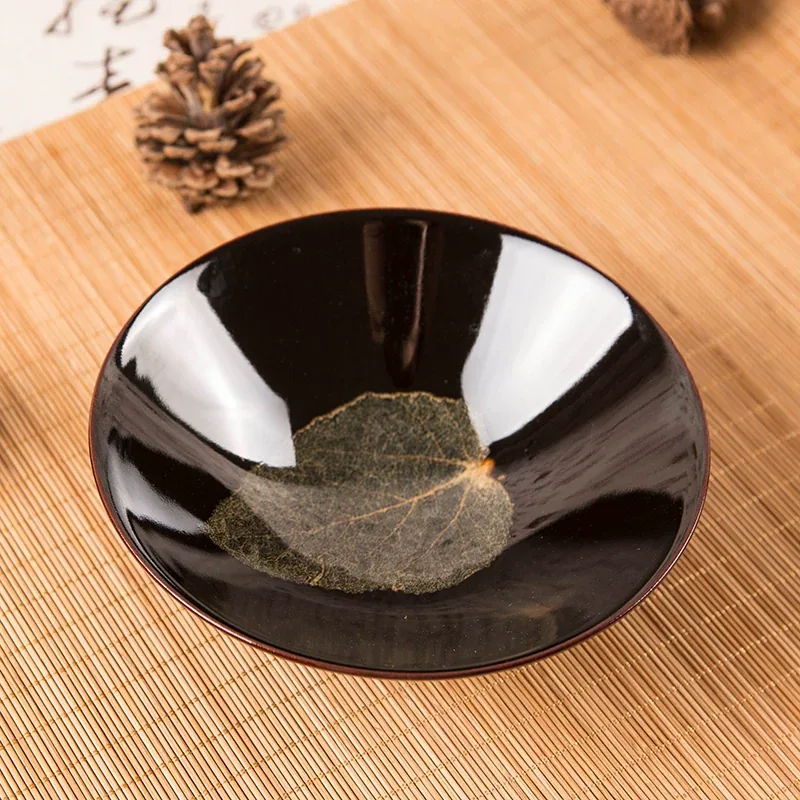
Lay one leaf on black glaze. When the bowl comes out, only the veins are left. It is a decoration no other kiln has ever produced.
The leaf burns, and stays
Konoha tenmoku was made at the Jizhou kiln in Yonghe, Ji'an, Jiangxi, during the Southern Song. An iron-rich black glaze goes onto the body. A mulberry leaf, treated so that it holds its shape, is laid on the wet glaze. A paler glaze is poured over it, and the bowl is fired.
The kiln reaches about 1,300°C. The leaf is consumed — but the calcium and silica it contains react with the glaze, and the pattern of the veins sets into the surface. Touch it: there is no ridge, no edge. The leaf has become the bowl.
Because one leaf leaves one pattern, no two bowls are the same. The old phrase for this is ichi yō itten — one leaf, one bowl — and sejō yō musō: under heaven, no second leaf.
The bowl reads better with water in it than empty. Move the water and the leaf moves with it, so a leaf that is fused into the glaze appears to be floating. That is where the image of a leaf adrift on water comes from. Fill it and the stem shows, with the veins branching away from it.
The kiln runs back to the late Tang
The Jizhou kiln is at Yonghe, in Ji'an, Jiangxi. It was opened in the late Tang, some twelve hundred years ago, spread through the Five Dynasties and the Northern Song, and reached its height under the Southern Song. The site is one of the best preserved of China's old kilns.
The kiln left two things to ceramic history: leaf tenmoku and cut-paper appliqué. Both lay something on the glaze and fire it there. Making a pattern without a brush was the habit of this kiln.
Three forms
| Form | Dimensions | Use |
|---|---|---|
| Standard bowl nami · round | 12–13 cm across, about 6 cm high | Everyday tea, matcha or sencha. The original form |
| Large bowl dai · round | 14–15 cm across, about 7 cm high | Room to whisk; works as a matcha bowl |
| Flat bowl hira · conical | about 15 cm across, about 5 cm high | Open mouth; the colour of the tea is easy to see. Also for sencha |
Dimensions vary from bowl to bowl. The measured figures are on each product page.
Three places to look
- Where the leaf sits. The tip should point toward the centre, and the leaf should not run to one side.
- Where the glaze breaks. Near the rim the glaze thins and the iron fires red-brown to gold. This is the bowl's weather, and it differs every time.
- How the foot ring is cut. The finish on the resting surface. This is where moulded copies give themselves away.
There is a longer version, in three points, under how to tell.
Questions
Can it be used as a matcha bowl?
Standard and large bowls both work. The large bowl, over fourteen centimetres across, is easier to whisk in. The flat bowl suits sencha.
How does leaf tenmoku differ from taiha?
Both are Jizhou techniques, and they work in opposite directions. A leaf is applied and keeps its shape; ash is scattered and becomes the mottling. There is more under taiha tenmoku.
Where is it made?
At Yonghe in Ji'an, Jiangxi, where the Jizhou kiln site is. The shop is run by the potter himself.
AVAILABLE
Leaf tenmoku in stock
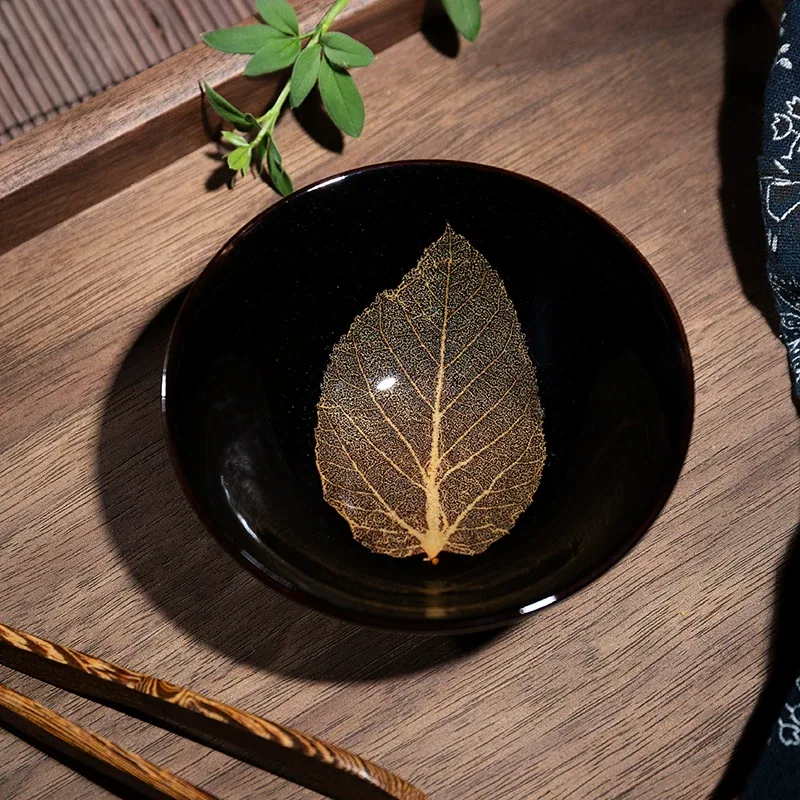 Konoha tenmoku / Standard bowl Konoha Tenmoku · Black Glaze — made by Luo Zhonghua A leaf under a glaze sunk to black. Fired by the potter himself, not by the workshop. matcha / sencha Price on request One of a kind Konoha tenmoku / Large bowl Konoha Tenmoku · Large Bowl, 15 cm Fifteen centimetres across. A large bowl with room for the whisk to work. 15.0 cm · matcha Price on request One of a kind
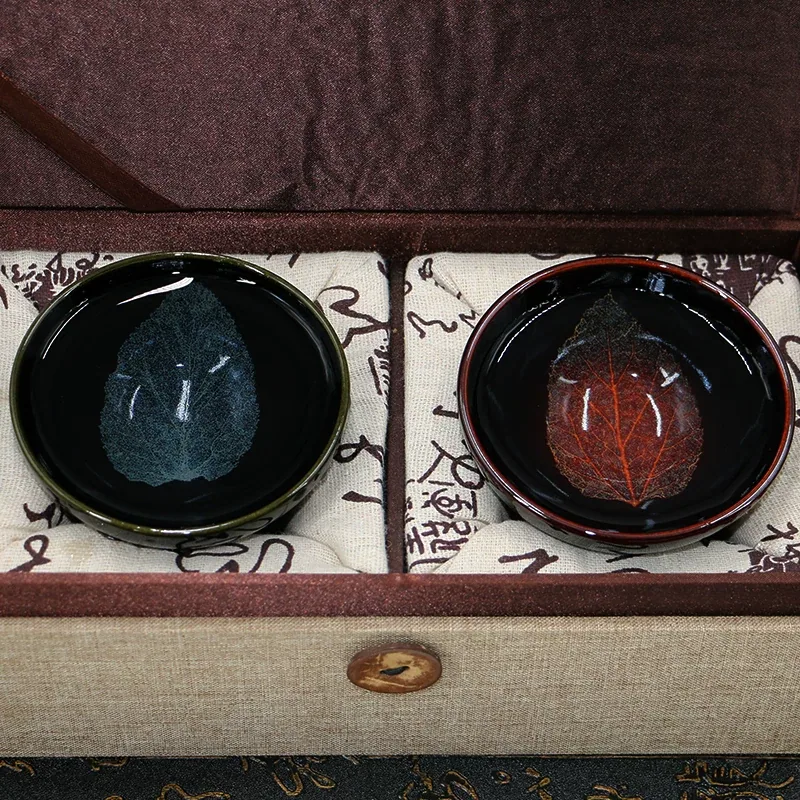 Konoha tenmoku / Two standard bowls Konoha Tenmoku · Pair of Bowls in a Paulownia Box Two bowls from the same firing, one blue and one red. Bought as a pair, boxed as a pair. matcha / sencha Price on request One of a kind
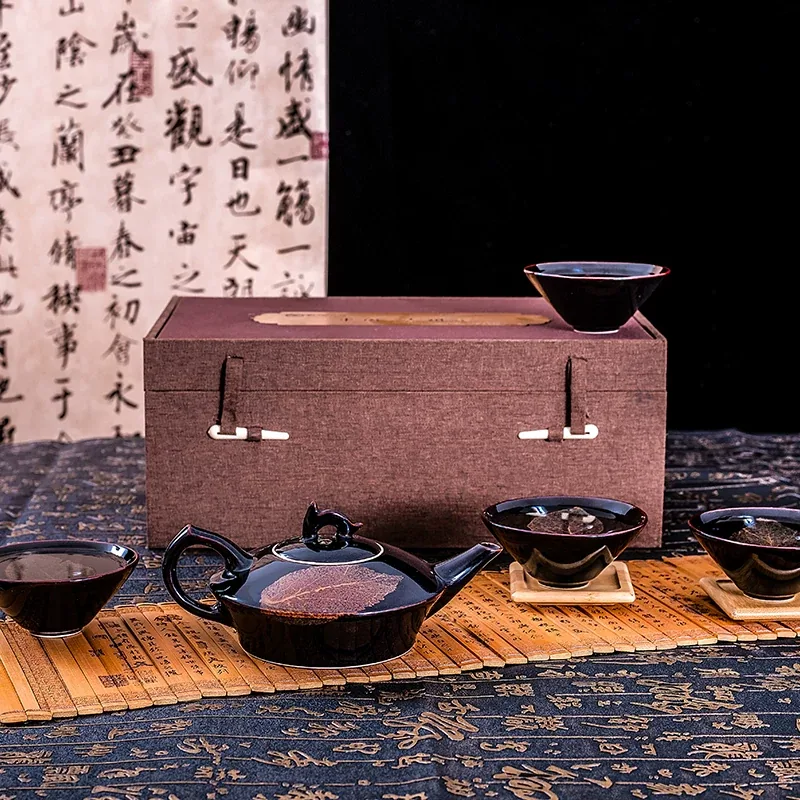 Konoha tenmoku / Pot and four cups Konoha Tenmoku · Five-piece Tea Set One pot, four cups, all in leaf tenmoku. A set built for sencha. sencha Price on request One of a kind
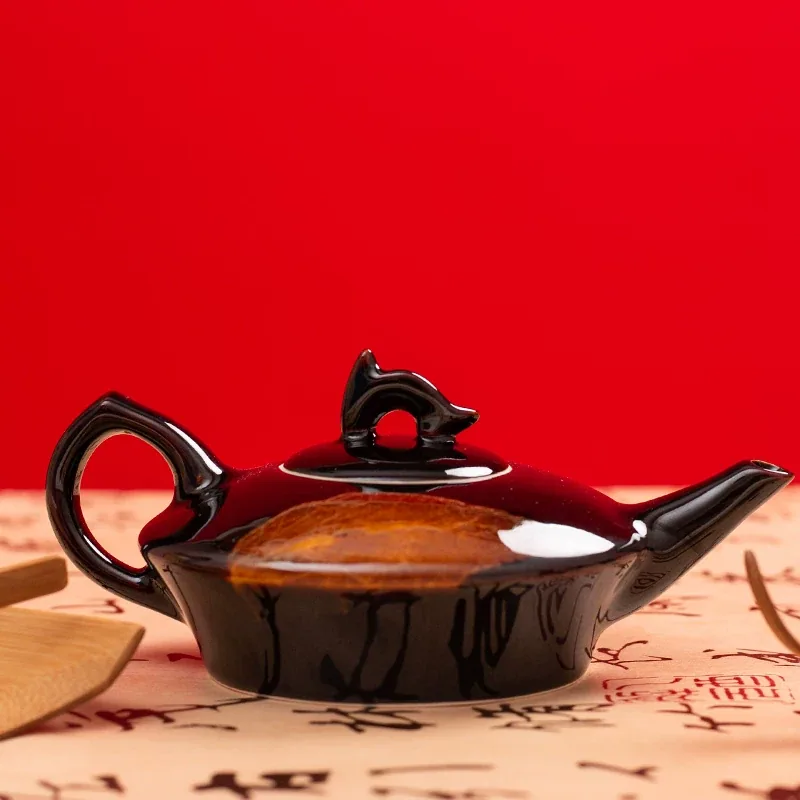 Konoha tenmoku / Teapot Konoha Tenmoku · Teapot A leaf on the body of the pot. Leaf tenmoku, made for sencha. sencha Price on request One of a kind
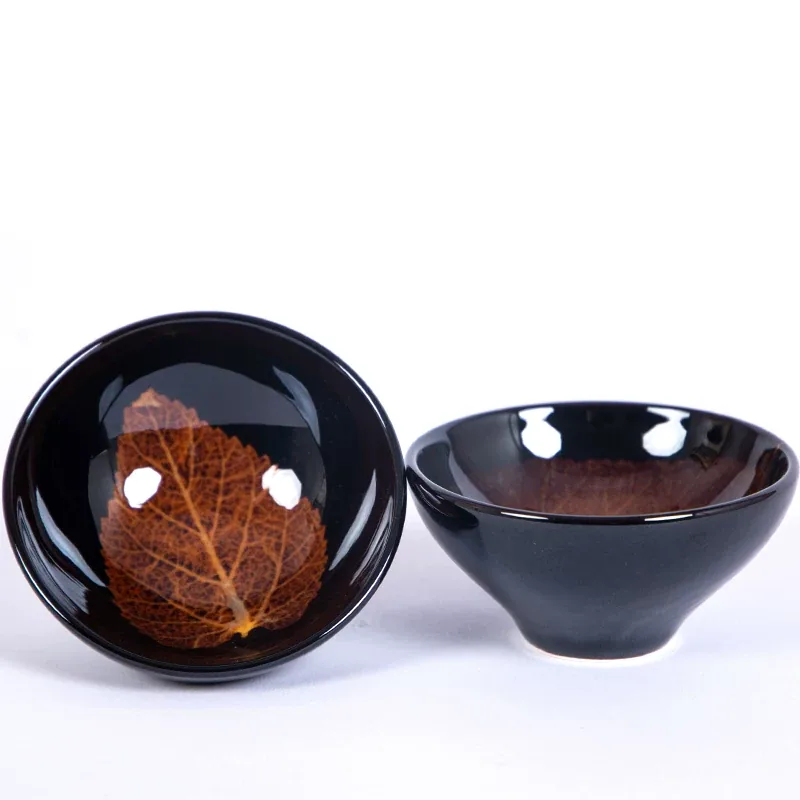 Konoha tenmoku / Standard bowl Konoha Tenmoku · Standard Bowl A first bowl. The round standard form, fired with a single leaf at the centre. matcha / sencha Price on request One of a kind