Types
Types of tenmoku
People speak of “the seven types”, but the count depends on the source. These seven are the ones with a clear kiln and a clear appearance.
Tenmoku is divided by kiln, by the behaviour of the glaze, and by decoration. Almost all of it can be explained by two kilns: Jian in Fujian and Jizhou in Ji’an, Jiangxi.
| Name | Written | Kiln | What to see | Rank |
|---|---|---|---|---|
| Yōhen tenmoku | 曜変天目 | Jian, Fujian | Iridescent blue and violet spots suspended in black glaze. Three complete examples survive, all National Treasures in Japan. | 1 |
| Yuteki tenmoku | 油滴天目 | Jian, Fujian | Silver spots, like beads of oil, across the black surface. One at the Museum of Oriental Ceramics, Osaka, is a National Treasure. | 2 |
| Nogime tenmoku | 禾目天目 | Jian, Fujian | Glaze drawn down into fine streaks, like rabbit fur. Known in Chinese as tumao zhan, the hare’s-fur bowl. | 3 |
| Taiha tenmoku | 玳玻天目 | Jizhou kiln, Ji’an, Jiangxi | Yellow-brown mottling over black, from rice-straw ash. Also called bekkyō. One at Shōkoku-ji is a National Treasure. | 4 |
| Konoha tenmoku | 木の葉天目 | Jizhou kiln, Ji’an, Jiangxi | A mulberry leaf fired against the glaze, leaving only its veins. A decoration unique to Jizhou. | — |
| Haikaburi tenmoku | 灰被天目 | Around Jian | Where the black glaze failed and ash settled instead, firing to a soft yellow-brown. Valued for its austerity. | — |
| Ki tenmoku | 黄天目 | Southern Chinese kilns | A yellow glaze close to haikaburi, prized in Japan at a turning point in tea taste. | — |
“Rank” follows the Muromachi order in Kundai Kan Sōchōki. Leaf tenmoku does not appear in it at all. The five National Treasure bowls are listed under National Treasures.
Three from Jian, two from Jizhou
Jizhou is the older name of Ji’an. The kiln site lies at Yonghe, a town within Ji’an, and the kiln takes its name from the earlier one.
Yōhen, yuteki and nogime are Jian. Taiha and konoha are Jizhou. Jian uses an iron-rich black body; Jizhou uses a pale body low in iron. That difference in clay is what changes how the glaze reads.
There is more on this under Jian ware and tenmoku.
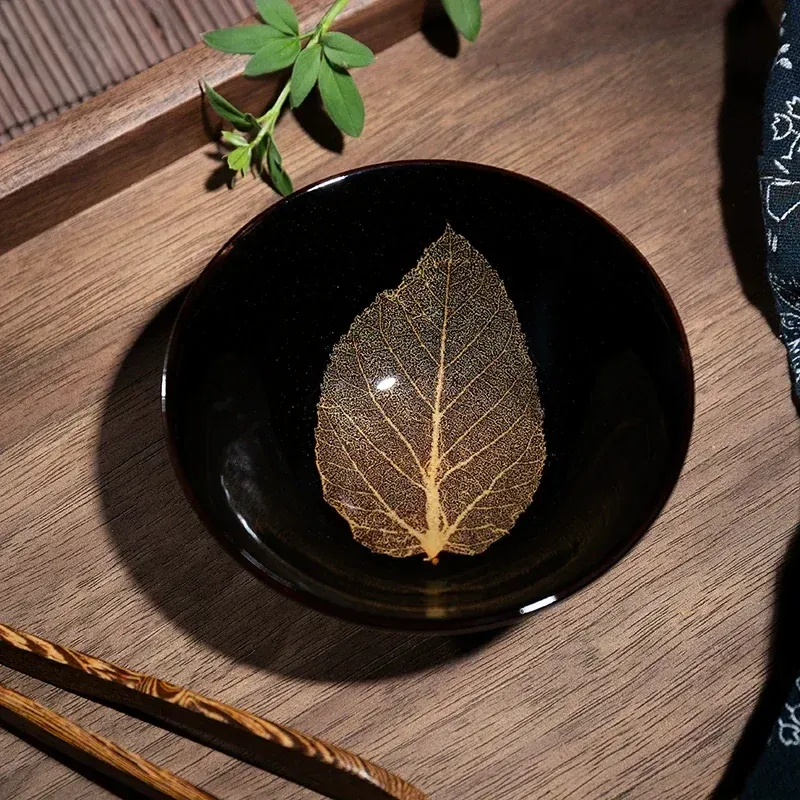
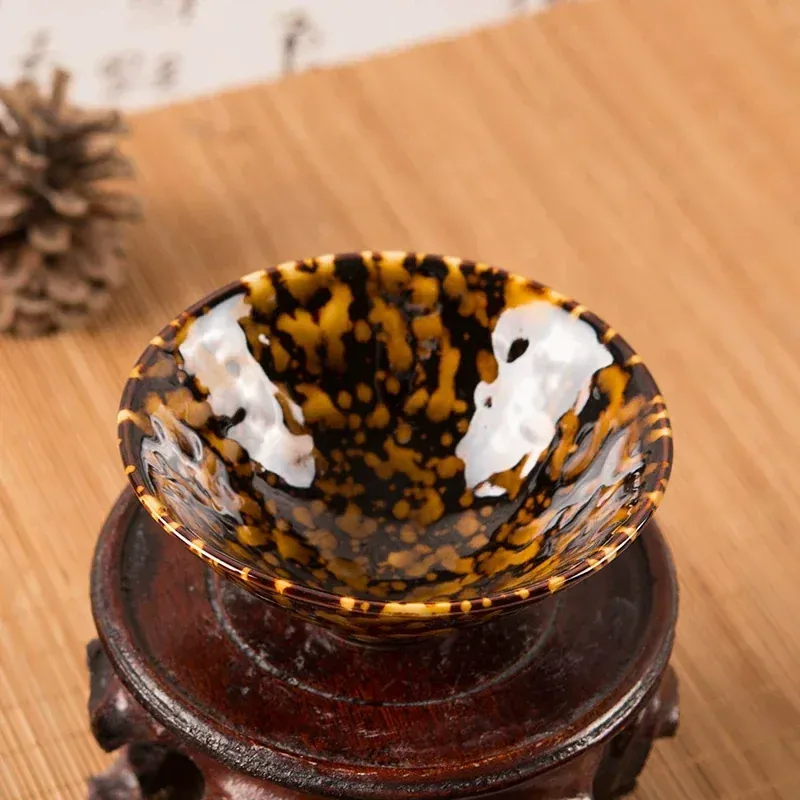
The photographs show the two Jizhou types we sell. For yōhen, yuteki and nogime, the bowls themselves are in museum collections.
Nogime tenmoku — streaks like rabbit fur
Nogime is a bowl with fine streaks running through the black glaze. Iron in the glaze crystallises out and sets as it flows, and the streaks are as fine and soft as rabbit fur. The Chinese name is tuhao, the hare's-fur bowl.
They are sorted by colour: silver, gold, blue. Silver is the prize, pale streaks carrying a silver light. The Kyoto National Museum holds a Southern Song hare's-fur bowl from Jian.
In the Muromachi ranking a hare's-fur bowl was worth three thousand hiki, behind yōhen at ten thousand and yuteki at five. Pour tea and the streaks show through the surface, shifting as the liquid moves.
NOTE — Leaf tenmoku stands outside the ranking
The four grades in Kundai Kan Sōchōki do not include leaf tenmoku. Jizhou leaf bowls were valued as ishoku-saku — work of a different colour — judged by design rather than rank. That is not a statement about quality, one way or the other.
Questions
Are there seven types of tenmoku?
The count depends on the source. Seven is common, but some lists give six by leaving out haikaburi. The kiln is a more reliable guide than the name.
Why is leaf tenmoku missing from the ranking?
The ranking graded imported Chinese wares, and applying a leaf sat outside that frame. Missing from the list does not mean ranked low.
What is the difference between jianzhan and tenmoku?
Jianzhan names bowls from the Jian kiln in Fujian. Tenmoku is the Japanese category, which includes Jian bowls and Jizhou bowls as well.
How many tenmoku are National Treasures?
Five: three yōhen, one yuteki, and one Jizhou taiha. The list is under National Treasures.